History of black jewellery
By the 1860s, Jablonec costume-jewellery production already had a hundred years of development behind it. It had firmly established itself not only in domestic awareness, but was also taken seriously abroad, and growing orders arrived in Jablonec for goods now demonstrably “Jablonec”.
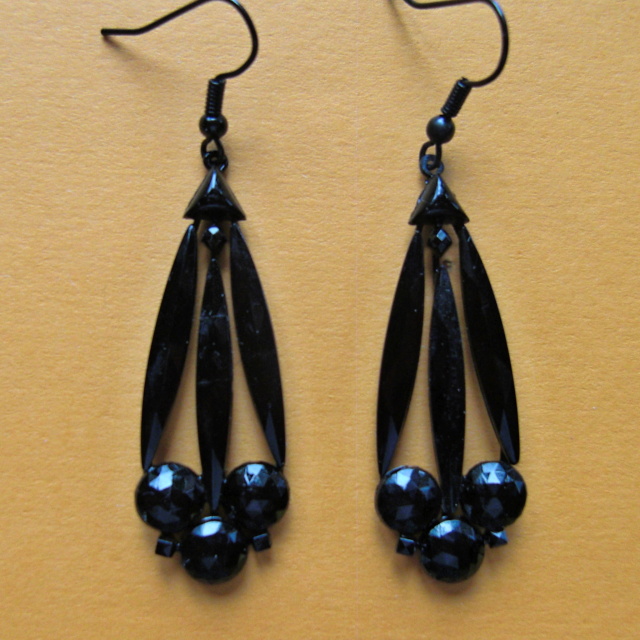
The favour of the age, emphasising glass ornament on dress, brought in the 1860s a boom such as the foothills of the Jizera Mountains had not yet seen. Demands from foreign — often exotic — markets, and the formal and functional peculiarity of jewellery meant for the most varied peoples of every continent, took their toll. Unusual stimuli, often ready-made patterns from outside, increasingly limited the independent creative work of jewellery makers. The pressure of an impersonal foreign market quickly led to mass imitation and alteration of foreign, predominantly French, formal innovations.
In this boom of mediocrity, only the glass button retained a special position; after 1864 it held world primacy in fashion. From its technological gains there then emerged, at the same time, another article that built on the best of costume-jewellery creation, returned wholly to the primacy of glass, and raised the Jablonec product to jewellery that was entirely distinctive, original and independent. At the close of the 1860s this became black jewellery.
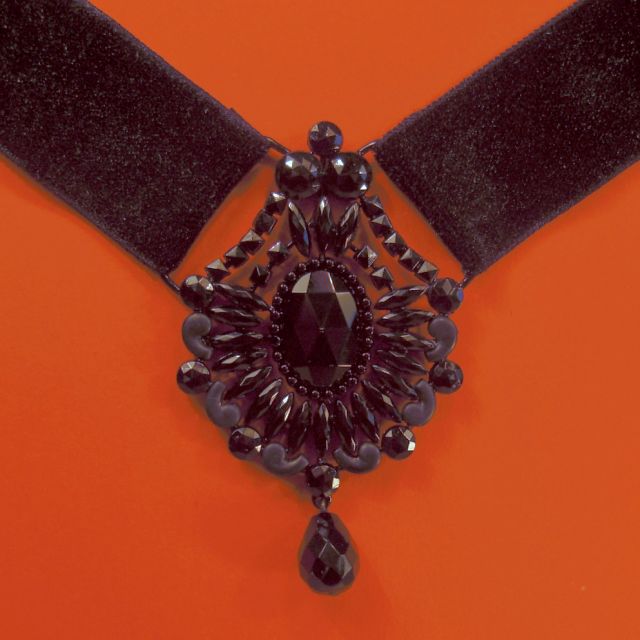
In its beginnings it responded to strengthening demand — mainly from the European market — for light and valuable dress and hat ornament. Besides proven brooches and buttons, hair clasps, combs and pins were most often made. The true flowering of black jewellery, however, still lay ahead.
Transferring the novelty — the technique of soldering with tin, which the small Tanvald maker Karel Fischer had learned at the firm Naudascher et Kahn in Stuttgart — to black jewellery was only a matter of time, suitable paraffin soldering lamps, and experience. The result was revolutionary and, in its later economic consequences, more significant than riveting.
The same stones were used; only the fused rivets were replaced by pressing in a brass hollow tube, often of tiny dimensions. A designed pattern of black jewellery — for example a clasp, pin, brooch, dress ornament or hair comb — was cast in plaster; the cast then served as a matrix for serial production. Individual glass stones were soldered onto wire. The wire construction thus replaced a heavy metal backing; riveting was succeeded by soft soldering. The result was maximally light jewellery: the metal base was reduced to a minimum, and the pure cut of the black stone dominated the piece.
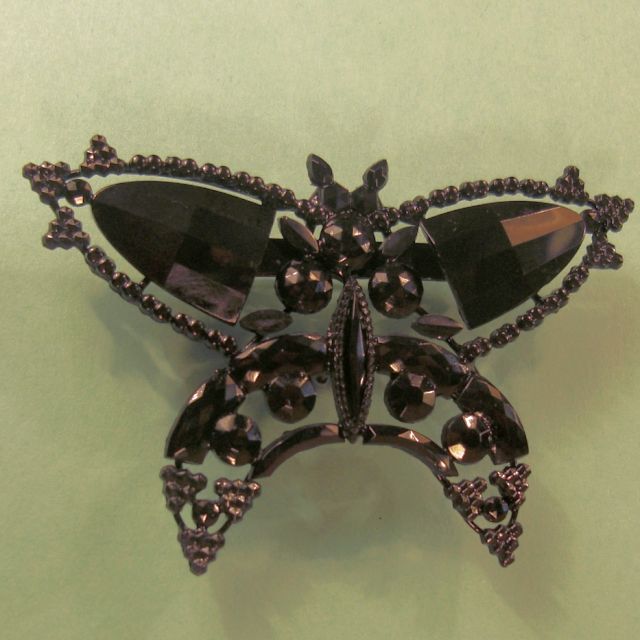
The new technique multiplied the formal possibilities of black jewellery to the very limits of the designer’s imagination. Moreover it required no special prior craft skills, nor capital investment in expensive foreign metal stampings still imported from France. It was what the Jizera landscape needed most — typical home work. Soft soldering with tin suited both the character of the jewellery and its domestic production base, the dispersed manufactory cottage industry around Smržovka.
Enormous demand for jewellery made this way brought jet jewellery in the 1890s to a high degree of perfection. With the death of Queen Victoria (1901), black jewellery became mourning jewellery for the countries of the British Empire. It became a world fashion. Its production and formal purity reached a peak never afterwards surpassed.
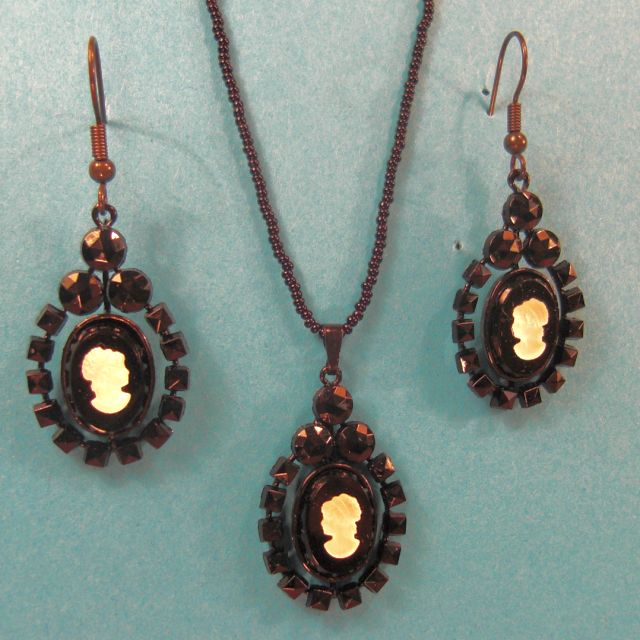
The Balkan Wars and rapidly changing fashion shifts led to more frequent and ever longer crises. Quality goods were replaced by devalued products. Strong competition from metal costume jewellery forced makers of glass goods to work in black jewellery. There was less bread for all.
The world economic crisis gradually struck every branch of Jablonec enterprise. Black jewellery, which for eighty years had successfully resisted fashion swings and crises, no longer had the strength to stand firm.
After the Second World War an attempt was made to revive it at the place of its origin. In the workshops of the once-famous Feix firm in Jiřetín it enjoyed two or three more years of renaissance. Then that too ended.
It fell into oblivion, like so many once-famous branches of Jablonec industry. Its production process and technological peculiarities were forgotten. Only somewhere in attic spaces stores of noble semi-finished goods survived — cut glass stones of every size and shape, those with tiny fused links meant for riveting, and the later ones for soldering — together with pliers, old plaster casts, metal backings, wires, galleries, cutting tools and matrices. And with them, rare old patterns.